
Olympus E-30
Olympus has introduced the E30, a first of its kind in pro-consumer digital SLR cameras from Olympus for the first time. With many advanced amateur photo shooters who really get knocked off by the plethora of Nikon’s D90 or Canon’s 50D camera intricacies, the Olympus E30 offers to be the better viable option in the “prosumer” or “semi-pro” segment.
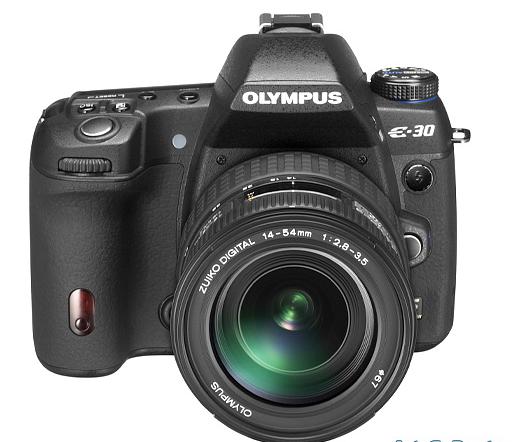
The E-30 fits in the spectrum of the E-System lineup above the E-520 as a mid-range advanced DSLR, while the E-3 remains at the top as the flagship Olympus DSLR. The E-30 promises to deliver the same high-precision performance and imaging quality demanded by professional photographers who use the E-3, as well as the consumer-friendly features found on the E-520
The Image Sensor
The E-30 features a newly designed 12.3 megapixel Live MOS imager that works in conjunction with the same open-format Four Thirds lens and body system that previous Olympus DSLRs have participated in. A new TruePic III+ processor rounds out the system’s imaging hardware, with the E-30 borrowing a variant of the professional E-3’s 11 point AF system and offering an upgraded version of Olympus’s well-known live view technology. The E30 offers autofocus speeds with a fully-biaxial 11-point AF, 5fps sequential shooting and a shutter that’s as fast as 1/8000th sec.
E-30 Body
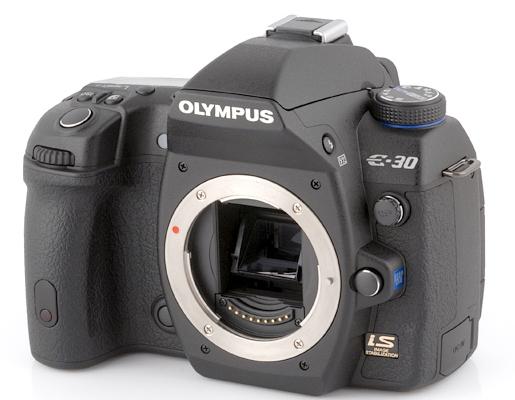
The Olympus E-30 body looks quite similar when it comes to the appearance of the E-3; however the housings of E-30 do differ vastly. Although the E-30 is built in a composite body whereas the professional E-3 is alloy, the mid-level Olympus carries several other design touches over from the advanced model in addition to its grip and its generally robust feel. A number of new buttons, and other buttons have either been replaced or have disappeared all together from E-3. The Olympus E30 digital SLR camera fits solidly and pleasantly in the hand. The buttons on the back of the camera next to the monitor are directly accessible with the thumb of your right hand, which adds to a swift operation.
LCD display and viewfinder
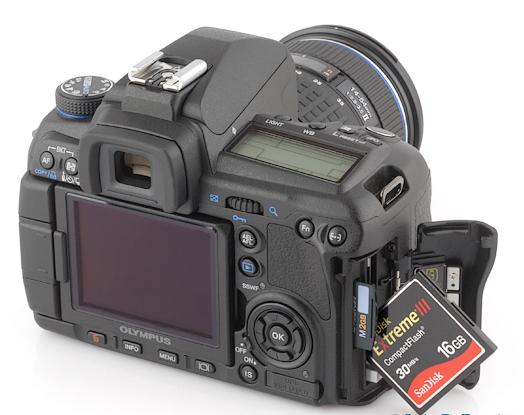
Framing can be undertaken through a conventional viewfinder which offers an approx 98% field of view and approx 1.02x magnification (-1m-1, 50mm, at infinity). Or, for greater flexibility, compositions can be framed using the 2.7” / 6.9cm HyperCrystal II LCD with 176° viewing angles. This offers complete framing freedom through its free-angle design which allows even the most adventurous perspectives to be captured. The effects of adjustments to settings can also be monitored in real time. LCD depictions are extremely fast and faithful, making Live View framing significantly more comfortable than before. Views can be enlarged by a factor of 5x, 7x or 10x, enabling the photographer to close-in on subject details to check, for example, the focus.
Olympus also claims to have improved the E-30’s live view system – namely in the arena of contrast-detection AF, which allows you to focus in live view mode without blacking out the preview to do it.
Shooting speed with the E-30
Photographers can also look forward to an accelerated experience in situations when every fraction of a second counts: up to 5fps can be recorded by the E-30 in full 12.3 Megapixel quality (with a 12 image RAW buffer in burst mode) for capturing fast-moving scenes. And for freezing high-speed action – or shooting in bright sunlight with the aperture wide open – this model enables shutter speeds as fast as 1/8000th sec. Flash synchronisation at up to 1/250th sec. further enhances its flexibility.
Camera speed with Autofocus System of E-30
Also with the new improved live view system, which allows you to focus in live view mode without blacking out the preview, is quite impressive when compared to the other cameras. But when most live view DSLRs (including Olympus’s previous models) still take several seconds to lock focus using contrast-detection AF, the E-30’s consistent sub-second performance feels like a big jump forward.
The E-30 offers two systems to quickly focus and capture the image. The other system – Phase Detection AF – This 11 point twin cross sensor provides world-class fast and accurate focusing. The E-30 takes advantage of the SWD lens speed. The alignment of the optical axis from the lens to the AF phase detection sensors combined with accurate mounting of the sensors within the AF unit delivers accurate and fast focusing.
E-30 Art Filters
New to the E-30 is technology is the feature of Art Filters, that Olympus claims to help photographers conveniently transform a basic image that faithfully represents the scene into an image that carries emotional impact. Art Filters are activated via the mode dial on the left side of the camera body, and the effects are viewable right on the new camera’s 100 percent accurate swivel 2.7-inch Live View HyperCrystal™ LCD. Olympus E-30 introduces the following art filters – Pop Art, Soft Focus, Pale & Light Color, Light Tone, Grainy Film, Pin Hole.
Technical Specifications
| Product type | Single-lens reflex Live View digital camera with interchangeable lens system |
| Memory | CompactFlash Type I/II (UDMA), Microdrive, xD-Picture Card (Dual-Slot) |
| Screen size | 17.3 mm (H) x 13.0 mm (V) |
| Lens mount | Four Thirds Mount |
Effective Pixels number
| Effective Pixels number | 12.3 million pixels |
Image Pickup Unit
| Product type | High speed Live MOS Sensor |
| Total no. of pixels | Approx. 13.1 million pixels |
| Aspect ratio | 1.33 (4:3) |
| Filter array | Primary color filter (RGB) |
| LPF | Fixed type |
| IR cut filter | Hybrid type |
| Dust reduction | Supersonic Wave Filter (dust reduction system for image sensor) |
Recording
| Recording format | DCF, DPOF compatible/Exif, PRINT Image Matching III |
| File format | RAW (12-bit lossless compression), JPEG, RAW+JPEG |
| Recording image size | [RAW] 4032 x 3024 pixels [JPEG] 4032 x 3024 pixels – 640 x 480 pixels |
| File size | RAW: 4032 x 3024 (approx. 1/1.5 lossless compressed) Approx. 13.9MB Large: 4032 x 3024 Super fine (1/2.7 compressed) Approx. 8.2MB 4032 x 3024 Fine (1/4 compressed) Approx. 5.7MB 4032 x 3024 Normal (1/8 compressed) Approx. 2.7MB Middle 3200 x 2400 Super fine (1/2.7 compressed) Approx. 5.4MB 3200 x 2400 Fine (1/4 compressed) Approx. 3.4MB 3200 x 2400 Normal (1/8 compressed) Approx. 1.7MB 3200 x 2400 Basic (1/12 compressed) Approx. 1.2MB 2560 x 1920 Super fine (1/2.7 compressed) Approx. 3.2MB 2560 x 1920 Fine (1/4 compressed) Approx. 2.2MB 2560 x 1920 Normal (1/8 compressed) Approx. 1.1MB 2560 x 1920 Basic (1/12 compressed) Approx. 0.8MB Small 1600 x 1200 Super fine (1/2.7 compressed) Approx. 1.3MB 1600 x 1200 Fine (1/4 compressed) Approx. 0.9MB 1600 x 1200 Normal (1/8 compressed) Approx. 0.5MB 1600 x 1200 Basic (1/12 compressed) Approx. 0.4MB 1280 x 960 Super fine (1/2.7 compressed) Approx. 0.9MB 1280 x 960 Fine (1/4 compressed) Approx. 0.6MB 1280 x 960 Normal (1/8 compressed) Approx. 0.3MB 1280 x 960 Basic (1/12 compressed) Approx. 0.3MB 1024 x 768 Super fine (1/2.7 compressed) Approx. 0.6MB 1024 x 768 Fine (1/4 compressed) Approx. 0.4MB 1024 x 768 Normal (1/8 compressed) Approx. 0.3MB 1024 x 768 Basic (1/12 compressed) Approx. 0.2MB 640 x 480 Super fine (1/2.7 compressed) Approx. 0.3MB 640 x 480 Fine (1/4 compressed) Approx. 0.2MB 640 x 480 Normal (1/8 compressed) Approx. 0.1MB 640 x 480 Basic (1/12 compressed) Approx. 0.1MB |
Viewfinder
| Product type | Eye-level single-lens reflex viewfinder |
| Field of view | Approx. 98% |
| Viewfinder magnification | Approx.1.02x (−1m-1, 50mm lens, infinity) |
| Eye point | Approx. 24.2 mm (-1m-1) from eyepiece lens |
| Diopter adjustment range | -3.0 – +1m-1 |
| Focusing screen | Neo Lumi-Micro Mat screen : FS-3 Grid Focusing Screen can be installed by Olympus Service. |
| Eyepiece shutter | Eye piece cover EPC-1 supplied |
| Eye cup | Interchangeable type EP-5/6/7, EP-5 is supplied (Magnifier Eyecup ME-1 is available) |
| Optical preview (view finder) | Yes, by preview button |
| Live preview | Available to set to Fn button |
| View finder information | Aperture value, Shutter speed, Record mode, AF confirmation mark, Flash, WB, AE lock, Number of storable still images, Exposure compensation value, Metering mode, Battery warning, Exposure mode, AF frame (super impose), IS, Bracket, ISO value |
Live View
| Live View | High speed Live MOS Sensor for still picture shooting is used, 100% field of view, Exposure adjustment pre-view, White balance adjustment pre-view, Gradation auto pre-view Face detection pre-view, Perfect shot pre-view Grid line displayable, 5x/7x/10x magnification possible, MF/S-AF, AF frame display, AF point display, Shooting information, Histogram, IS activating mode. |
| AF | High speed imager AF, Phase-difference detection AF |
Image Stabilizer
| System | Built in (Imager shift image stabilizer) |
| Mode | 3 modes (2 dimensional activation, 1 dimensional activation in landscape frame to vertical direction moving, 1 dimensional activation in portrait frame to horizontal direction moving ) |
| Manual Function | input focal length 8, 10, 12, 16, 18, 24, 28, 30, 35, 40, 48, 50, 55, 65, 70, 75, 80, 85, 90, 100, 105, 120, 135, 150, 200, 210, 250, 300, 350, 400, 500, 600, 800, 1000 |
| Effective compensation range | Approx.5 EV steps (in maximum effect) |
LCD Display
| Product type | HyperCrystal II LCD (semi-transmissive TFT color LCD) |
| Size | 2.7 inches |
| Total no. of pixels | Approx. 230,000 pixels |
| Playback field of view | 100% |
| Brightness control | 15 levels |
| Color Balance | 15 levels |
Focusing
| AF system | TTL phase-difference detection system Contrast detection system (with 25mm f2.8, 14-42mm f3.5-5.6, 40-150mm f4.0-5.6, 9-18mm f4.0-5.6, 14-54mm f2.8-3.5II) |
| Focus mode | Single AF (S-AF) / Continuous AF (C-AF) / Manual Focus (MF) S-AF + MF / C-AF + MF * C-AF mode is not available with the contrast detection system |
| Focusing point | 11 points full-twin cross AF sensor with the phase-difference detection system 11-area multiple AF with the contrast detection system (Auto, selectable in option) |
| Focusing point selection | Single target, Dynamic single target, All targets with the phase-difference detection system Single, all 11 area, or Face detection with the contrast detection system |
| AF luminance range (phase-difference detection system) | EV -2 to 19 (at 20℃, ISO 100) |
| AF illuminator (phase-difference detection system) | Built-in flash (external flash available) |
| AF lock | Locked at first position of Shutter button in Single AF mode / AEL button (customizable) |
| Focus tracking (phase-difference detection system) | Interlocked with Continuous AF mode |
| Focus aid | Available |
| Fine Adjustment | +/- 20 steps, 20 data can be registered |
Exposure Control
| Metering system | TTL open-aperture metering system (1) Digital ESP metering (49-points multi pattern metering) (2) Centre weighted average metering (3) Spot metering (approx. 2% for the viewfinder screen. Highlight / shadow bases are available) |
| Metering range | EV 1 – 20 (Digital ESP metering, Centre weighted average metering, Spot metering) (At normal temperature, 50mm f2, ISO 100) |
| Exposure mode | (1) Auto (2) P: Program AE (Program shift can be performed) (3) A: Aperture priority AE (4) S: Shutter priority AE (5) M: Manual (6) Scene program AE (7) Scene select AE |
| Scene program AE | Portrait, Landscape, Macro, Sport, Night + Portrait |
| Scene select AE | Children, High Key, Low Key, DIS mode, Nature Macro, Candle, Sunset, Fireworks, Documents, AUTO (ISO 100 – 3200) / Manual (ISO 100 – 3200), 1/3 or 1 EV steps |
| ISO sensitivity | AUTO (ISO 100 – 3200) / Manual (ISO 100 – 3200), 1/3 or 1 EV steps |
| Exposure compensation | ±5 EV in 1/3, 1/2, 1 EV steps selectable |
| AE lock | AEL button (customizable) |
| Exposure bracketing | 3 or 5 frames in 0.3, 0.5, 0.7, 1EV steps selectable |
| ISO bracketing | 3 frames in 0.3, 0.7, 1EV steps selectable |
| Metering standard value adjustment | 1/6 EV step, +/- 1EV range |
White Balance
| Auto WB system | Hybrid detection system with High speed Live MOS sensor and dedicated external sensor. |
| Preset white balance | 8 settings (3000K – 7500K) Lamp (3000K), Fluorescent 1 (4000K), Fluorescent 2 (4500K), Fluorescent 3 (6600K), Daylight (5300K), Flash (5500K), Cloudy (6000K), Shade (7500K) |
| White balance compensation | ±7 steps in each A-B/G-M axis (in Auto WB / Preset WB mode / One touch WB) |
| CWB (Kelvin setting) | 1 setting can be registered at Kelvin temperature (2000K – 14000K) |
| One-touch white balance | 1 custom setting can be registered |
| White balance bracketing | 3 frames in 2, 4, 6 steps selectable in each A-B/G-M axis. |
Color Mode
| Color space | sRGB, Adobe RGB |
Picture Mode
| Mode | Vivid, Natural, Portrait, Muted, Monotone, Custom (default setting: Natural) In custom mode, basic 5 modes and adjustment is available. |
| Adjustment parameter | Contrast, Sharpness and Saturation level available in 5 steps for Vivid, Natural, Portrait and Muted Contrast and Sharpness level available in 5 steps for Monotone. |
| Filter effect | Yellow, Orange, Red or Green filter available for Monotone |
| Picture tone | Sepia, Blue, Purple or Green tone available for Monotone |
| Gradation | 4 levels (Auto, High key, Normal, Low key) |
Shutter
| Product type | Computerized focal-plane shutter |
| Shutter speed | P(Ps), S, A, M mode: 60 – 1/8000 sec. Bulb: up to 30 min. (selectable longest time in the menu. Default: 8 min. TBD 1/3, 1/2, or 1EV steps selectable. |
| Self-timer | Operation time: 12 sec., 2 sec. (cancel available) |
| Remote cable release | Available (with optional RM-UC1 Remote cable.) |
| Optical remote control | Operation time: 2 sec., 0 sec., bulb control available (with optional RM-1 remote control) |
| Anti shock mode | Available (1 to 30 sec selectable) |
Drive
| Drive mode | Single-frame shooting, Sequential shooting H, Sequential shooting L, Self-timer, Remote control |
| Sequential shooting speed | Approx. 5 frames/sec. in sequential shooting H, 1 to 4 fps selectable in sequential shooting L. |
| Max. recordable pictureson sequential shooting | RAW mode: Max. 12 frames. |
| JPEG mode: Depends on compression ratio and no. of pixels (Large normal mode: up to card capacity with High Speed CF cards) |
Integrated Flash
| Built-in flash | Retractable flash, GN=18 @ISO200, (GN=13 @ISO 100.m) |
| Compatible external flash | FL-50R, FL-36R, FL-50, FL-36, FL-20 |
| Flash control mode | TTL Auto (TTL pre-flash mode), Auto, Manual |
| Flash mode | Auto, Red-eye reduction, Red-eye reduction slow sync., Slow sync at 1st curtain, Slow sync at 2nd curtain, Fill-in, Manual (1/4, 1/16, 1/64), Off. |
| Synchronization speed | 1/250 sec. or less |
| Flash intensity control | Up to ±3 EV in 0.3, 0.5, 1 EV steps |
| Flash bracketing | 3 frames in 0.3, 0.5, 0.7, 1 EV steps selectable. |
Wireless flash control
| Compatible external flash | FL-50R, FL-36R |
| Control method | Triggered and controlled by built-in flash light |
| Flash control modes | TTL Auto (TTL pre-flash mode), Auto, Manual, FP TTL Auto, FP Manual. |
| Number of channels | 4 channels |
| Group setting | 3 groups |
Art Filter
| Mode | Pop Art, Soft Focus, Pale&Light Color, Light Tone, Grainy Film, Pin Hole |
Multi Exposure
| Number of picture | 2-4 pictures |
| Functions | Auto gain, Live View, Exposing on Recorded picture |
Multi Aspect
| Aspect Ratio | 4:3(Default)/3:2/16:9/6:6/5:4/7:6/6:5/7:5/3:4 |
Level Gauge
Control panel
| Information | WB setting, WB compensation notification, B/W mode notification, Record mode, ISO sensitivity, Program Sift |
| BKT notification, Flash mode, Drive mode, Recordable still image number, Shutter Speed, Aperture Value | |
| Exposure compensation value, Metering mode, AF mode, Activated AF points, Focusing mode, IS, Multi Exposure | |
| Back light timer | 8 sec. |
Super control panel
| Information (Shooting) | Battery information, Exposure mode, Shutter speed, Aperture value, Exposure compensation value, ISO sensitivity, |
| Exposure compensation indicator, Exposure indicator, Flash intensity compensation indicator, Date, BKT setting, | |
| NR setting, WB, WB compensation value, Picture mode, Flash mode, Record mode, Image size, Card information, | |
| Drive mode, Flash intensity compensation value, Metering mode, Recordable still image number, Focusing mode, | |
| FP warning, AF frame, AF illuminator deactivated notification, , Color space, Sharpness, Contrast, Saturation, | |
| Gradation, IS activating mode, Face detection, RC mode setting, My Mode, Flush Charge, Multi Exposure, Aspect Ratio | |
| Information (Wireless flash commander) | Exposure mode, Shutter speed, Aperture value, Exposure compensation value bar, Exposure compensation value |
| Flash compensation value bar, Flash compensation value, ALE notification, Flash compensation notification | |
| NR notification, BKT notification, AF illuminator deactivated notification, Color space | |
| Wireless channel setting, Built-in flash intensity, Group setting | |
| Back light timer | Back light lighting time is selectable. (Keep, 8, 30sec, 1min) |
Playback
| Playback modes | Single-frame, Index (4/9/16/25/49/100 frames), Calendar, Close-up ( 2 – 14X), Slideshow, Picture rotation (auto mode available), Light box |
| Information display | Histogram (independent luminance / RGB available), Highlight / Shadow point warning, AF frame, Shooting information |
Menu
| Languages | Japan: Japanese, English (Additional one language is possible to download.) Others: English, French, German, Spanish, Italian, Japanese, Korean, Traditional Chinese, Simplified Chinese, Russian, Czech, Dutch, Danish, Polish, Portuguese, Swedish, Norwegian, Finnish, Croat, Slovenian, Hungarian, Greek, Slovakian, Turkish, Latvian, Estonian, Lithuanian, Ukrainian, Serbian, Bulgarian, Rumanian, Indonesian, Malay, Thai |
Reset & custom setting
| Custom reset | 2 setting recordable |
| My mode | 2 setting recordable |
Image Editing
| Erasing function | Single frame, All frames, Selected frames |
| Protect function | Single frame, Selected frames, Release protect (Single/All selected) |
| Copy between media | Single frame, All frames, Selected frames |
| RAW picture editing | RAW development |
| JPEG editing | Shadow adjustment, Red-eye fix, Trimming, Monotone, Sepia, Saturation (color depth), Resize (producing another file), Aspect Change |
| Marge function | 2-4 pictures, merge gain step 0.1-2.0 0.1 step |
| Print function | Print reservation (DPOF), Direct print (PictBridge compatible) |
Input/Output
| PC interface | USB 2.0 High Speed for storage and camera control (MTP mode is available) |
| USB/Video connector | Dedicated multi-connector (Video: NTSC/PAL selectable, Optional Remote cable RM-UC1 is available) |
| Flash attachment | Hot shoe / External flash connector |
| DC-in | Yes (AC-1 compatible) |
Power Requirements
| Battery | BLM-1 Li-ion battery (included) |
| Sleep mode | Available (1, 3, 5, 10 min., off selectable) |
| No. of recordable pictures | Approx. 750 shots (optical viewfinder) |
| (with 50% flash light) | (with BLM-1 under CIPA testing standard) |
| Power battery holder | HLD-4 compatible |
Dimensions/Weight
| Dimensions | 141.5 mm (W) x 107.5mm (H) x 75 mm (D) (excluding protrusions) |
| Weight | 655g (body only) |
Operating Environment
| Temperature | 0 – 40℃ (operation) / -20 – 60℃ (storage) |
| Humidity | 30 – 90% (operation) / 10 – 90% (storage) |
Splash proof
| No |
Box contents
| Body, Li-ion battery BLM-1, Li-ion battery charger BCM-2, USB/Video Multi cable, Eye piece cover EPC-1, Shoulder strap, OLYMPUS Master CD-ROM, Instruction manual, Warranty card. |